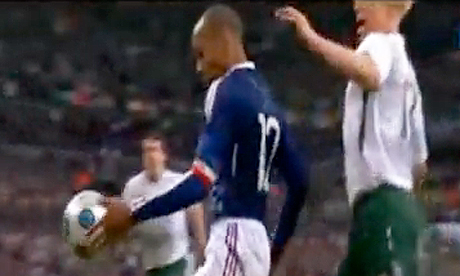
Taking us all for a ride: Thierry 'I'm no cheat'
Henry is trying to salvage his tattered commercial
reputation
What car did Thierry Henry famously advertise? Why a
Renault, of course, silly. It couldn’t have been anything
else.
Maybe he’ll deliberately steer his Clio into a wall at the Stade
de France one day just to complete the circle of Gallic
cheating.
Mr Va-Va-Voom surfaced again on Friday, announcing with
exquisite timing that it would be ‘the fairest solution’ to replay
the World Cup play-off decider against Ireland.
I say exquisite timing because this clarion call for justice
came just a few hours after FIFA had announced categorically there
was no absolutely no chance - none, nil, nul, nada - that the game
would be replayed in the lifetime of this galaxy.
The perfect moment, then, for Henry to offer up his plea, in the
vain hope that part of his shredded commercial image might be
salvaged.
‘Yes, I handled the ball but I am not a cheat and never have
been,’ he said. How odd. In the aftermath of the game his message
was very different.
‘Look, I don’t make the rules,’ he shrugged. Oh no, forgive me,
that was actually a scripted line from his Renault car advert,
although this was pretty much what he was saying anyway after he
steered the Republic of Ireland out of the World Cup.
Henry can now plan his summer in South Africa, review his
agent’s suggestions for a positive publicity campaign and leave
everyone else to pick up the pieces.
Amid the fuss, people scrabbled for solutions. Most were
horribly familiar. But one plan was gaining ground among
ex-referees and commentators. It was the suggestion that officials
should simply ask players to admit whether they had cheated.
After giving this proposal an enormous amount of thought,
applying some well-worn logic to the scheme and examining the pros
and cons from every angle, my considered reaction is: HAHAHAHA!
The idea that the same football players who spend pretty much
all their working hours actively trying to con officials, opponents
and the public by diving, time-wasting, shirt-pulling, elbowing,
appealing for corners and throw-ins, stealing yards at free-kicks,
and generally utilising every trick in the book - and some that
aren’t - to gain an unfair advantage, would suddenly default to
‘honest mode’ when a referee asked them if they had been a bad boy
is truly delightful.
The trouble is, most of us know the average player would lie,
take a chance on the subsequent video footage being inconclusive,
or plot to overturn any subsequent punishment with an expensive
lawyer.
There is no prevailing sense of honour in the game any more.
There is no moral code. Rules are not there to be enforced, but to
be flouted. Cheating is routinely described as ‘part of the game’.
Cold, hard, cynical professionalism is the order of the day.
Henry summed it up when discussing the Irish debacle: ‘Should I
stop and tell the referee? No. That is very funny. You are very
funny.’
Oh, yes, Thierry. We’re all holding our sides. Meanwhile, old
pros were loathe to condemn him, repeating the ‘it’s down to the
referee’ mantra and boring us all with their ‘I would have done the
same’ confessions.
David Beckham chipped in: ‘I honestly didn’t think Henry meant
it. I don’t think he’s a cheat.’ Yeah, thanks David. Maybe try a
little less of that thinking in future.
In this instance, Henry certainly is a cheat and, what’s more,
he knows it. He just daren’t explicitly say as much. ‘It was
necessary to exploit what was exploitable,’ he argued. Which sums
up the situation nicely. Jonny Wilkinson, that fine English
ambassador, put it in similar terms: ‘You get away with what you
can,’ he said.
This attitude explains why cricketers claim false catches and
batsmen refuse to walk when they have edged the ball. It is why
cyclists and track and field athletes are constantly caught in drug
stings.
When everyone else is doing it, cheating seems a rational
choice. Expediency is the law. Being sportsmanlike actually takes
an effort of will. It’s more natural today to try to cheat.
So if we cannot expect sportsmen - and footballers in particular
- to improve their behaviour, we must find better ways of enforcing
the laws.
For years I’ve argued there is no need for video evidence in
football. I’ve said that human error is part of sport and the rules
should be the same for all forms of the game, from the local
recreation field all the way up to Wembley.
Sod that. Not any more. Not when one cheat can deny a country
£1billion in revenue and a summer of unforgettable sporting
history. Bring in the cameras.
Clubs and national federations already have to comply with basic
standards of stadium facilities and security.
There is no reason why the same criteria cannot be applied to
simple review technology.
The gadgetry is cheap, referees already wear earpieces and every
match of consequence is televised these days, anyway. So it
wouldn’t take much to double-check key moments. Britain has 4.2
million surveillance cameras. Point all of them at the pitch.
Its time has come.